healthcare cost analysis
Analyzed healthcare facility distribution, funding allocation, and emergency response efficiency to identify urban-rural healthcare disparities and provide data-driven policy recommendations.
Project Overview
This project analyzes healthcare facility distribution, funding allocation, and emergency response efficiency across urban and rural regions to identify healthcare access disparities and support data-driven healthcare policy decisions.
The objective of this analysis was to evaluate how healthcare resources are distributed, determine whether funding allocation is equitable, assess operational efficiency across facility types, and provide recommendations that improve healthcare accessibility in underserved populations.
Business Problem
Healthcare access inequality remains one of the biggest challenges facing many healthcare systems, particularly in underserved rural communities.
Decision makers need to understand whether healthcare funding is being allocated efficiently, whether healthcare facilities are properly distributed across regions, and which operational inefficiencies are preventing equal healthcare access.
Key Metrics Tracked
- Total Healthcare Facilities
- Funding Allocation by Region
- Average Emergency Response Time
- Funding Per Patient Visit
- Healthcare Facility Efficiency Rate
- Urban vs Rural Healthcare Distribution Ratio
Analysis Objectives
- Evaluate healthcare facility distribution across urban and rural regions.
- Compare funding allocation between urban and rural healthcare facilities.
- Analyze the relationship between funding levels and emergency response time.
- Determine the operational efficiency of different healthcare facility types.
- Identify major factors driving healthcare inequality.
- Provide policy recommendations for improving healthcare access.
Healthcare Facility Distribution Analysis
- Urban areas showed significantly higher concentration of healthcare facilities.
- Patients in urban regions had shorter travel distance to medical services.
- Rural populations had fewer available healthcare facilities and reduced healthcare accessibility.
- Longer travel distances created barriers to accessing critical medical care in rural communities.
Funding Allocation Analysis
- Urban healthcare facilities received higher average funding compared to rural facilities.
- Higher funding levels allowed urban facilities to maintain stronger infrastructure and employ more medical professionals.
- Rural healthcare centers remained underfunded, directly impacting service quality and patient satisfaction.
Emergency Response Analysis
The analysis found no strong correlation between healthcare funding and emergency response time.
This suggests that increasing funding alone may not improve emergency response performance and that operational management factors may play a larger role.
Facility Efficiency Analysis
Rural Areas
- Hospitals received the highest funding and handled the largest patient volume, making them the most efficient facility type.
- Clinics operated with lower funding while still delivering cost-effective patient care.
- Health Centers had the highest funding per patient visit, making them the least efficient facility type.
Urban Areas
- Hospitals demonstrated the highest operational efficiency across all facility types.
Key Findings
- Healthcare infrastructure is concentrated heavily in urban areas.
- Rural healthcare facilities are significantly underfunded.
- Funding alone does not directly improve emergency response times.
- Hospitals showed the strongest operational efficiency in both urban and rural regions.
- Healthcare inequality is driven by infrastructure gaps, funding disparity, and shortage of healthcare professionals.
Policy Recommendations
- Increase healthcare funding allocation for rural healthcare facilities.
- Develop public-private partnerships to improve rural healthcare infrastructure.
- Implement data-driven funding allocation models based on facility performance and patient demand.
- Prioritize hospital expansion in underserved rural communities.
- Improve accountability and transparency in healthcare expenditure management.
Business Impact of Analysis
Governments and healthcare organizations can use this analysis to improve healthcare resource allocation, reduce inequality in healthcare access, optimize facility performance, and make better investment decisions that improve healthcare delivery outcomes.
The project demonstrates how data analytics can directly support policy decisions that affect public health systems and long-term healthcare planning.
Conclusion
This analysis revealed significant healthcare disparities between urban and rural populations, particularly in facility availability and funding allocation.
By applying data-driven decision making, policymakers can design more equitable healthcare systems that improve access, operational efficiency, and long-term healthcare outcomes across underserved communities.
Dashboard Preview
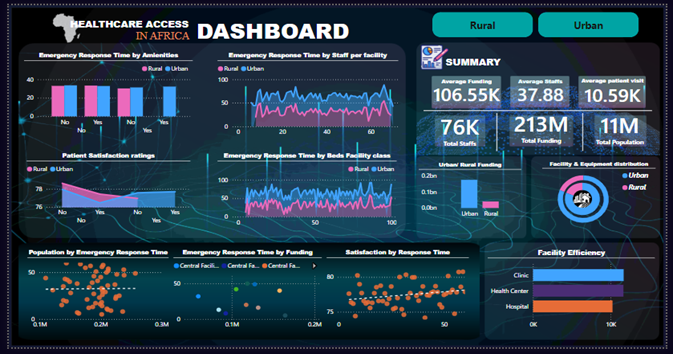 View Interactive Power BI Dashboard